Why Users Don't Discover New Features | Announcify
Product Updates8 min read
Why Users Don't Discover New Features
Aug 17, 2026
Ahmed Errami
Introduction
You can spend weeks building a new feature, launch it to your customers, and still have most of them never use it.
This happens more often than SaaS founders expect.
The feature might solve a real customer problem. It might be well-designed and thoroughly tested. You might even announce it in an email.
Yet customers still miss it.
The problem isn't always the feature.
Often, it's feature discovery.
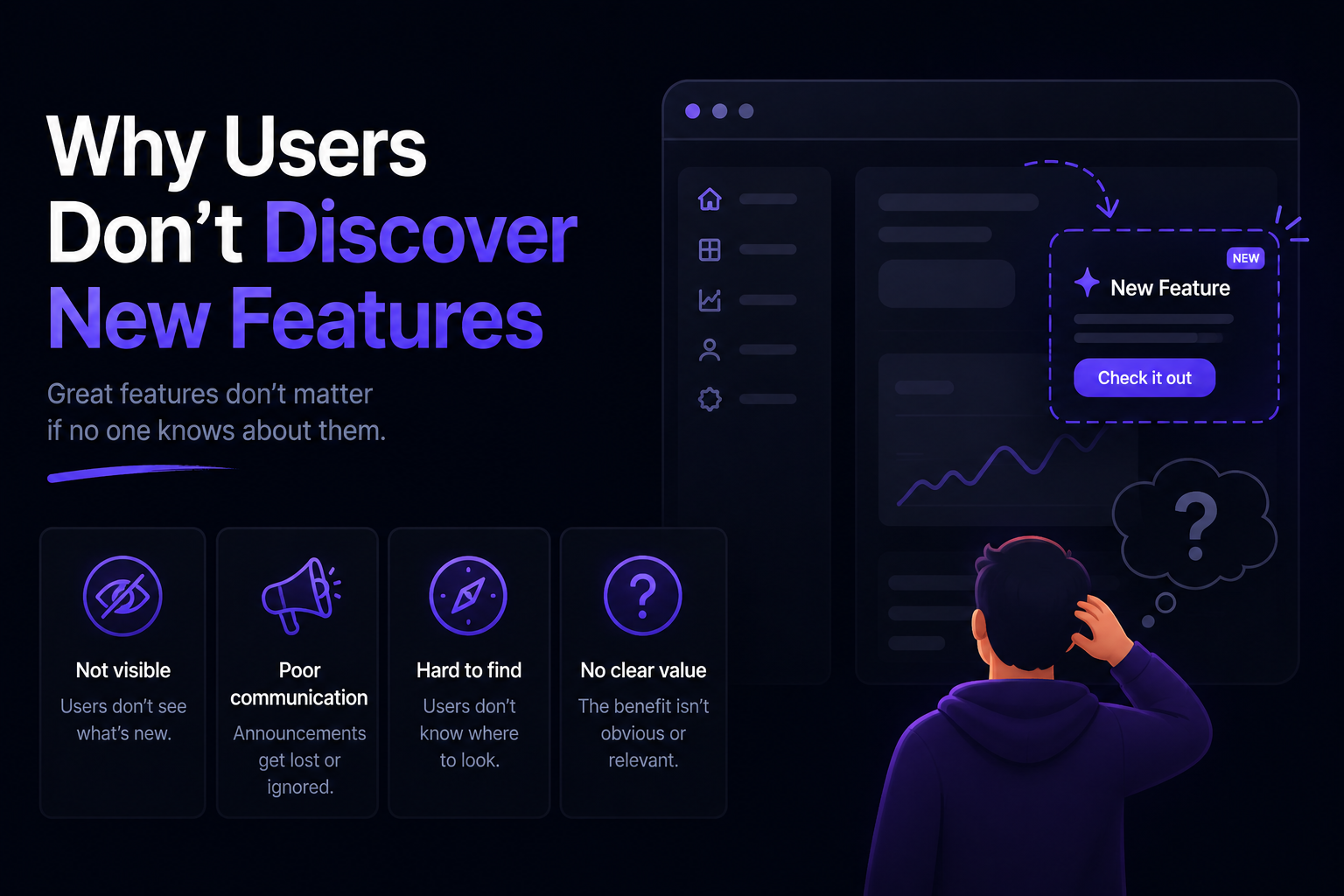
Customers aren't constantly exploring every part of your product. They're usually focused on completing a specific task. If a new feature isn't visible at the right moment or clearly connected to something they care about, they may never discover it.
And when customers don't discover a feature, they can't adopt it.
In this guide, we'll look at why users don't discover new SaaS features and what you can do to make important product updates easier to find.
You'll learn how to use:
In-app announcements
Product onboarding
Changelogs
Email
Tooltips and contextual guidance
Documentation
Better feature messaging
The goal isn't to constantly interrupt users with announcements.
easy to discover when customers actually need them
Why Feature Discovery Matters
Building a feature doesn't guarantee that customers will use it.
There is a gap between feature availability and feature adoption.
Your development team might see a new feature every day. Your customers don't.
They only see the parts of your product that are visible, understandable, and relevant to their current needs.
A Feature Can Exist Without Being Discovered
Imagine you add a new export option to your SaaS product.
The feature is live.
Your documentation has been updated.
The code works perfectly.
But the option is hidden inside a settings page that most customers rarely visit.
From your team's perspective, the feature has been shipped.
From the customer's perspective, it might as well not exist.
This is why feature discovery should be treated as part of the product experience, not something that happens automatically after development.
Discovery Comes Before Adoption
Customers generally need to go through several steps before a new feature creates value:
Discover → Understand → Try → Use → Adopt
If the first step fails, everything after it fails too.
A customer can't understand a feature they never see.
They can't try a feature they don't know exists.
And they can't adopt a feature they never try.
Low Adoption Doesn't Always Mean Low Demand
When a new feature has low usage, it's tempting to assume customers don't want it.
But there could be another explanation.
Customers might:
Not know the feature exists
See it but not understand what it does
Not know where to find it
Not understand why they need it
Forget about it after seeing the announcement
Find the feature difficult to use
Have no reason to use it yet
Before removing a feature or deciding that customers don't want it, find out where the discovery process is breaking down.
Feature Discovery Is a Product Communication Problem
Feature discovery sits somewhere between product design and customer communication.
Your interface needs to make features discoverable.
Your communication needs to make their value clear.
Your onboarding needs to introduce relevant functionality.
Your changelog needs to provide a place where customers can see what has changed.
When these pieces work together, customers have more opportunities to discover features naturally.
The Goal Isn't Maximum Exposure
You don't need every customer to see every feature.
A feature should be discoverable by the customers who are most likely to benefit from it.
Showing an advanced reporting feature to someone who never uses reports isn't helpful.
Showing it to a customer who manually exports data every week might be extremely useful.
Good feature discovery is not about showing more announcements.
It's about showing the right feature to the right customer at the right time.
1. Users Don't Know the Feature Exists
The most obvious reason users don't discover new features is also one of the most common:
You didn't tell them about it clearly enough.
SaaS teams often assume that customers will notice new functionality because it's visible somewhere in the product.
Usually, they won't.
Customers have habits. They know where to click to accomplish the tasks they already perform, and they often have no reason to explore unfamiliar parts of the interface.
Why Customers Miss New Features
A customer might log into your product every day and still never notice a feature because:
They go directly to the pages they normally use
The feature is outside their usual workflow
The UI changed only slightly
The feature is hidden behind a menu
They don't regularly explore settings
They missed the announcement email
This is especially common with features that don't immediately appear in a user's normal workflow.
Don't Rely on Users to Explore Your Product
If a feature is important, don't expect customers to discover it accidentally.
Give them a reason to notice it.
For example, you could use an in-app announcement:
New: Schedule reports automatically
You can now schedule reports and receive them automatically every Monday.
Set up your first report →
The announcement explains what changed, why it matters, and what the customer can do next.
Tell Customers About Important Updates
You don't need to announce every small change.
But important features should have a clear communication plan.
Depending on the feature, you might use:
In-app announcements
Email
A public changelog
Product tours
Documentation
Onboarding
Social media
The goal is to create multiple opportunities for customers to discover the feature.
Make the Announcement Useful
Simply saying:
"We've launched a new feature."
isn't enough.
Explain what customers can now accomplish.
Instead of:
"Introducing Advanced Filters."
Try:
"Find exactly what you're looking for faster with Advanced Filters."
The second message immediately gives the customer a reason to care.
2. The Feature Is Hidden in the Interface
Sometimes users know a feature exists but still struggle to find it.
This happens when functionality is buried inside menus, settings pages, dropdowns, or unfamiliar parts of the product.
Make Important Features Easy to Find
Consider where the feature naturally belongs in the user's workflow.
If a customer needs to visit Settings → Integrations → Advanced → Export to access the feature, there's a good chance many users will never find it.
You don't necessarily need to put every feature on the main dashboard.
Instead, make the feature discoverable where the relevant task happens.
For example, if you've added bulk editing, surface it when users select multiple items.
If you've added scheduling, show the option when users create or edit the relevant item.
This is known as contextual discovery.
The feature appears at the moment when the customer has a reason to use it.
Reduce the Number of Steps
Every additional click makes discovery harder.
Ask yourself:
"If a customer needs this feature, how would they naturally expect to find it?"
Then design the experience around that expectation.
A feature shouldn't require customers to memorize where you decided to put it.
3. Users Don't Understand Why They Need the Feature
Sometimes customers see a new feature but don't use it because they don't understand its value.
This is a messaging problem.
A feature name can tell users what something is without explaining why they should care.
For example:
Smart Segmentation
This sounds interesting, but it doesn't tell the customer much.
Compare it with:
Send updates to the right customers with Smart Segmentation
Now the benefit is clearer.
Explain the Problem Before the Feature
Good feature messaging connects the feature to a problem the customer already understands.
Instead of focusing on what your team built, explain what the customer can now do.
For example:
Weak:
"We've added custom filters to your dashboard."
Better:
"Find specific customers faster by filtering your dashboard by plan, activity, or signup date."
The second version gives customers a reason to try the feature.
Focus on Outcomes
When introducing a feature, answer three questions:
What does it do?
What problem does it solve?
What can I do with it now?
The answers don't need to be complicated.
A simple explanation is often more effective than a long product announcement full of technical details.
Show the Feature in Context
Whenever possible, show customers how the feature fits into their existing workflow.
For example:
"If you currently export your data manually every Friday, you can now schedule the report and have it delivered automatically."
This is much more compelling than:
"We've added automated report scheduling."
The first message connects the feature to something the customer already does.
4. The Feature Is Introduced at the Wrong Time
Even a useful feature can be ignored if customers see it at the wrong moment.
Imagine you're working quickly to complete an important task when an application suddenly shows you a tutorial for an unrelated feature.
You probably won't read it.
Timing matters.
Contextual Discovery Works Better
Try to introduce features when they're relevant to the customer's current activity.
For example:
Show a collaboration feature when a user invites a teammate.
Show an automation feature after a user repeatedly performs the same task.
Show an export feature when a user views a report.
Show an integration when a user visits the integrations section.
The customer already has context for the feature.
You aren't creating a new problem they need to think about.
Don't Interrupt Users Unnecessarily
Feature discovery doesn't mean showing popups everywhere.
Too many announcements can become noise.
If customers constantly see banners, tooltips, and popups, they'll eventually learn to dismiss them without reading.
Use interruptions selectively.
Reserve them for features that are genuinely relevant or important.
For everything else, let customers discover updates through your changelog, product navigation, documentation, or other passive channels.
5. Users Miss the Announcement Email
Email is a useful way to announce new features, but it shouldn't be your only discovery channel.
Customers can easily miss an email because:
They're busy
They receive hundreds of emails
The subject line isn't compelling
They don't check their inbox regularly
The feature isn't relevant when they receive the email
The email gets ignored or filtered
This doesn't mean email is ineffective.
It means you shouldn't depend on it alone.
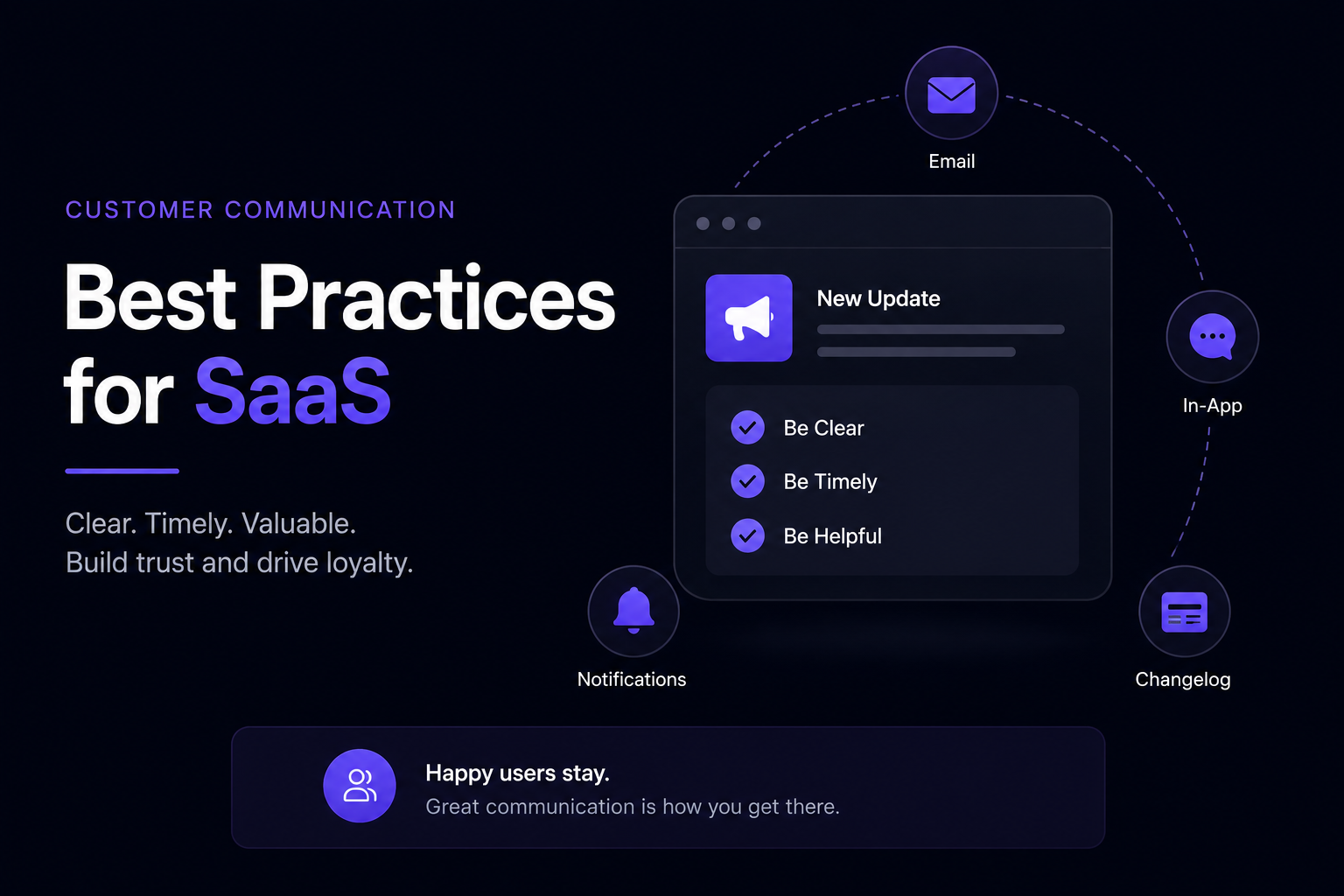
Use Multiple Discovery Channels
For an important feature, consider combining:
Email: Get the update directly in front of customers.
In-app announcement: Reach customers when they're actively using your product.
Changelog: Give customers a permanent place to discover and revisit updates.
Documentation: Explain how to use the feature.
Onboarding: Introduce the feature to new customers when it's relevant.
Each channel serves a different purpose.
6. Your Changelog Is Hard to Find
A changelog can be one of the easiest ways for customers to discover product updates, but only if they can actually find it.
If your changelog is buried somewhere on your website and customers don't know it exists, it won't contribute much to feature discovery.
Make your changelog easy to access from places customers already visit.
For example:
Your product navigation
Your website
Your help center
Your in-app changelog widget
Your account dashboard
You can also link directly to individual updates from emails, support conversations, and social posts.
A good changelog becomes a permanent record of what's new instead of relying on customers to remember an announcement they saw weeks ago.
7. Users Don't Have a Reason to Try the Feature
Even when customers know a feature exists and understand what it does, they may still not use it.
Awareness isn't the same as motivation.
Customers are more likely to try a feature when they can immediately see how it benefits them.
Give Users a Clear Next Step
Don't end an announcement with information alone.
Give customers something simple to do.
For example:
New: Automated reports
Schedule your weekly reports and have them delivered automatically.
Create your first scheduled report →
The call to action removes uncertainty.
The customer knows exactly what to do next.
Connect the Feature to an Existing Problem
The strongest reason to try a feature is usually a problem the customer already has.
For example:
"Still copying data into spreadsheets every Monday? You can now automate the entire report."
This creates a connection between the customer's current workflow and the new capability.
You're not asking them to learn something new for no reason.
You're offering a better way to solve something they already need to do.
Make the First Experience Easy
Even motivated users can abandon a feature if the first experience is complicated.
Reduce the time between:
"I want to try this"
and
"This is useful."
Use sensible defaults, examples, templates, or a short onboarding flow when appropriate.
The faster customers experience the value, the more likely they are to continue using the feature.
8. You Announce Features Once and Move On
One announcement is rarely enough.
Customers aren't all going to see your update at the same time, and not everyone who sees it will need the feature immediately.
Someone might see your announcement today but only encounter the problem the feature solves three weeks later.
If you never mention the feature again, they may forget about it.
Keep Important Features Discoverable
You don't need to repeatedly send the same email.
Instead, use different opportunities to surface the feature:
Include it in your changelog
Add it to relevant onboarding flows
Mention it in documentation
Surface it inside the product
Create a tutorial
Link to it from relevant help articles
Mention it when talking to customers
The goal is not repetition for the sake of repetition.
The goal is to make the feature discoverable when customers have a reason to use it.
9. The Feature Doesn't Fit the User's Workflow
Sometimes the problem isn't communication.
The feature simply requires customers to change too much of what they're already doing.
People naturally prefer familiar workflows.
If your new feature requires them to completely change how they work, adoption will be harder.
Design Features Around Existing Behavior
Look at how customers currently solve the problem.
Then make the new feature fit naturally into that process.
For example, if customers already create reports from a particular dashboard, adding automated scheduling directly there is easier to discover than creating a completely separate workflow.
The closer a feature is to an existing customer behavior, the easier it is to discover and adopt.
10. You Don't Measure Feature Discovery
If you don't measure discovery, you won't know where customers are getting stuck.
Low feature usage could mean many different things.
Maybe customers never saw the announcement.
Maybe they saw it but didn't understand it.
Maybe they understood it but couldn't find the feature.
Maybe they tried it and abandoned it.
These are very different problems.
Track the Journey
Where possible, measure the steps between announcement and adoption:
Announcement seen → Feature viewed → Feature tried → Feature used → Feature used repeatedly
This helps you identify where customers are dropping off.
For example, if many users see your announcement but very few open the feature, the problem may be your messaging or call to action.
If many users open the feature but don't complete the setup, the problem may be onboarding or usability.
If customers try the feature but don't return, the feature itself may not be providing enough value.
Feature Discovery Is an Ongoing Process
Your job doesn't end when the feature goes live.
Keep looking for ways to help the right customers discover it at the right time.
The best SaaS products don't simply add features.
They create clear paths that help customers find, understand, try, and adopt those features.
How to Improve Feature Discovery in Your SaaS
If customers aren't discovering your new features, you don't necessarily need to build more features.
You may simply need a better system for helping customers find the ones you've already built.
Here are practical ways to improve feature discovery.
1. Add an In-App Announcement
An in-app announcement puts your update directly in front of customers while they're using your product.
Use it for important features that you want active users to notice.
Keep the message short:
What's new?
Why does it matter?
What should the user do next?
Avoid long explanations inside the announcement itself.
Link to a detailed changelog entry, documentation page, or feature walkthrough when customers need more information.
2. Create a Public Changelog
A public changelog gives customers a permanent place to see what's changing in your product.
Instead of relying on a single email or popup, customers can return to the changelog whenever they want to catch up.
A good changelog can also help potential customers see that your product is actively maintained and improving.
Keep each update focused on the customer:
What changed
Why it matters
How to use it
Who benefits from it
3. Improve Your Feature Onboarding
Some features require more explanation than others.
For complex features, consider adding:
Tooltips
Product tours
Setup checklists
Templates
Examples
Short walkthroughs
Don't introduce everything at once.
Show customers the information they need when they need it.
4. Use Contextual Prompts
The best time to introduce a feature is often when the customer encounters the problem it solves.
For example:
"You're doing this manually. You can now automate it."
This is more relevant than showing the same announcement to everyone.
Contextual prompts can make feature discovery feel like helpful guidance instead of advertising.
5. Improve Your Product Navigation
Sometimes the simplest solution is to make the feature easier to find.
Review your navigation and ask:
Is the feature where customers would expect it?
Is the name clear?
Is it hidden behind too many menus?
Can customers find it through search?
Is it visible from the relevant workflow?
Good information architecture can eliminate the need for additional announcements.
6. Update Your Documentation
Documentation isn't just for troubleshooting.
It can also help customers discover functionality they didn't know existed.
When publishing documentation, connect related features together.
For example:
"You can also automate this process using scheduled workflows."
Then link directly to the relevant feature documentation.
This creates additional paths for customers to discover useful functionality.
7. Add New Features to Onboarding
New customers are often more willing to explore your product than existing customers.
Use onboarding to introduce features that are relevant to their goals.
Don't overwhelm new users with a tour of every feature.
Instead, introduce functionality progressively as customers reach the point where it becomes useful.
8. Use Email Strategically
Email can still be one of the most effective ways to communicate major product updates.
But focus on value rather than simply listing what changed.
Instead of:
"We added five new features this month."
Try:
"You can now automate your weekly reports, invite your team, and export your data in one click."
Make the benefit obvious and give readers a clear next step.
9. Resurface Important Features
Some features deserve more than one discovery opportunity.
You can resurface them through:
Product onboarding
Tutorials
Customer newsletters
In-app messages
Documentation
Relevant support conversations
Feature pages
The key is relevance.
Don't repeatedly promote a feature to customers who have no reason to use it.
10. Make Feature Discovery Part of Your Launch Process
Don't wait until after a feature is built to think about discovery.
Add feature discovery to your launch checklist.
Before releasing a feature, ask:
How will customers find it?
Who needs to know about it?
Where should it appear in the product?
What problem should the announcement focus on?
What documentation is needed?
What should the customer do after discovering it?
How will we measure adoption?
This turns feature discovery from an afterthought into part of your product launch strategy.
Build a System, Not a One-Time Announcement
Feature discovery shouldn't depend on one email, one popup, or one social media post.
Build a system where customers can discover updates through multiple touchpoints.
Together, these channels create a much stronger path from new feature → discovery → adoption.
How to Know If Your Feature Discovery Is Working
Improving feature discovery is only useful if you can tell whether it's actually working.
Don't look at one metric in isolation. Look at the entire journey from seeing the update to repeatedly using the feature.
Track Feature Adoption
Start with the percentage of eligible users who use the feature.
For example, if 1,000 customers could use a new feature and 250 use it, your adoption rate is 25%.
This gives you a baseline you can compare over time.
But adoption alone doesn't tell you where the problem is.
Track Feature Discovery
If possible, measure how many users actually encounter your feature announcement or entry point.
You could track:
In-app announcement views
Changelog views
Email opens
Email clicks
Feature page visits
Documentation visits
This helps separate a discovery problem from an adoption problem.
If only 10% of customers see the announcement, low adoption may simply be caused by poor visibility.
If 80% see it but only 2% use the feature, something else is probably preventing adoption.
Track Time to First Use
Another useful metric is the time between discovering a feature and actually using it.
If customers see your announcement but wait weeks before trying the feature, there may be too much friction between discovery and action.
A shorter time to first use can indicate that your:
Messaging is clear
Call to action is effective
Onboarding is simple
Feature is easy to access
Track Repeat Usage
Trying a feature once doesn't necessarily mean customers adopted it.
Look at whether users come back.
For example:
Used once
Used three times
Used weekly
Used as part of a regular workflow
Repeated usage is often a stronger signal that the feature provides real value.
Compare Different Discovery Channels
If you're using multiple channels, compare their performance.
For example:
Channel
What to Measure
Email
Opens, clicks, feature usage
In-app announcement
Views, clicks, feature usage
Changelog
Views, clicks, feature usage
Documentation
Visits, feature usage
Onboarding
Completion, feature usage
Over time, you'll learn which channels are most effective for your audience.
You may discover that email works well for major announcements while in-app messages are much better at driving immediate feature usage.
Talk to Customers
Analytics can tell you what is happening.
Customer conversations can help you understand why.
If a feature has low adoption, ask customers:
"Did you know this feature existed?"
"What did you think it did?"
"Would you use it? If not, why?"
"Was it easy to find?"
These simple questions can uncover problems that analytics alone can't explain.
Don't Optimize for Clicks
It's easy to get distracted by announcement metrics.
A high click-through rate doesn't necessarily mean the feature is successful.
The ultimate goal isn't to get customers to click an announcement.
It's to help them discover something useful and get value from it.
A better measurement chain is:
Seen → Understood → Tried → Adopted → Used repeatedly
The further customers move through this journey, the stronger your feature discovery system is.
A Simple Feature Discovery Strategy for SaaS
You don't need a complicated system to improve feature discovery.
Start with a few consistent channels and use each one for a specific purpose.
Step 1: Announce the Feature
When a meaningful feature launches, tell customers what changed and why it matters.
Use an email, in-app announcement, or both depending on the importance of the feature.
Keep the message focused on the customer outcome.
Step 2: Add It to Your Changelog
Publish a detailed changelog entry that customers can return to later.
Include:
What changed
Why you built it
Who it's useful for
How to get started
Screenshots or examples when useful
This gives customers a permanent reference instead of making the announcement disappear after launch day.
Step 3: Surface It Inside the Product
Don't make customers leave the product to understand what they can now do.
If the feature is relevant to a specific workflow, introduce it there.
For example, if you launch a new reporting feature, make it visible from the reporting area rather than expecting customers to find it through a general announcement.
Step 4: Add Contextual Guidance
For features that require some learning, provide guidance when customers encounter the relevant workflow.
A tooltip, short explanation, or example can be enough.
The goal is to help customers understand the feature without forcing them through a long product tour.
Step 5: Follow Up
Don't assume everyone who missed the launch will eventually discover the feature.
For important features, look for opportunities to mention them again.
You might:
Create a tutorial
Add the feature to onboarding
Mention it in your newsletter
Link to it from documentation
Share an example
Surface it to users who haven't tried it
Step 6: Measure Adoption
Finally, check what happened.
Ask:
How many customers discovered the feature?
How many tried it?
How many continue using it?
Which discovery channel performed best?
Where are customers dropping off?
Use those insights to improve both the feature and your next launch.
Make Feature Discovery Part of Every Launch
Feature discovery shouldn't be something you think about after development is finished.
It should be part of the feature launch process from the beginning.
When planning a new feature, ask:
How will customers discover this?
Why will they care?
Where will they encounter it?
What will help them get started?
How will we measure adoption?
Answering these questions before launch can prevent a common SaaS problem: building something valuable that customers never use.
Frequently Asked Questions
Why don't users discover new features?
Users often don't discover new features because they're focused on their existing workflows rather than exploring the product.
Other common reasons include poor navigation, unclear messaging, hidden functionality, weak onboarding, and relying on a single announcement channel.
How do I get users to notice new features?
Use multiple discovery channels instead of relying on one announcement.
For important features, consider using:
In-app announcements
Email
A public changelog
Contextual tooltips
Product onboarding
Documentation
Tutorials
The most effective approach depends on the feature and your customers.
Should I announce every new feature?
No.
Major features and important improvements usually deserve an announcement.
Small bug fixes, minor UI changes, and low-impact improvements can simply be added to your changelog.
This keeps your communication useful without overwhelming customers.
Is a changelog good for feature discovery?
Yes.
A changelog gives customers a permanent place to discover and revisit product updates.
It also allows you to communicate frequent improvements without sending an email for every change.
How can I improve feature adoption?
Start by improving discovery, then reduce the friction between discovering and using the feature.
Make sure customers:
Know the feature exists
Understand why it's useful
Can easily find it
Know how to get started
Have a reason to use it
Then measure adoption and collect customer feedback.
Should I use in-app announcements for new features?
In-app announcements are particularly useful because they reach customers while they're already using your product.
They're especially effective when the announcement is relevant to the customer's current workflow.
However, avoid showing too many popups or messages. Too many interruptions can cause users to ignore future announcements.
How often should I remind users about a new feature?
There isn't a fixed number.
For important features, give customers multiple opportunities to discover them rather than repeatedly sending the same announcement.
You can introduce the feature through an initial announcement and later surface it through onboarding, documentation, contextual prompts, tutorials, or relevant workflows.
What is the difference between feature discovery and feature adoption?
Feature discovery is when a customer becomes aware of a feature and understands what it does.
Feature adoption happens when the customer actually starts using the feature as part of their workflow.
Discovery comes first.
You can't adopt a feature you never discover.
How do I know if users are not discovering a feature?
Look at the difference between exposure and usage.
For example, if very few customers see your announcement or visit the feature, you probably have a discovery problem.
If many customers see the feature but very few try it, the problem could be messaging, usability, or perceived value.
Should I use a product tour for every new feature?
No.
Product tours work best for features that require explanation or involve a new workflow.
For simple improvements, a short in-app message or contextual hint may be enough.
The goal is to provide the minimum guidance necessary to help customers understand and use the feature.
Conclusion
Building a useful feature is only half the job.
If customers don't discover it, they can't use it. And if they don't use it, the work your team put into building it won't create much value.
The solution isn't to show more popups or send more emails.
It's to create a better path from feature launch to feature adoption.
Make important features easy to find. Explain why they matter. Introduce them when they're relevant. Give customers a clear way to get started, and keep important updates discoverable after launch.
Your changelog can document what changed, in-app announcements can bring important updates to active users, and contextual guidance can help customers discover features when they actually need them.
Most importantly, don't assume low feature adoption means customers don't want the feature.
Sometimes they simply don't know it exists.
Make Your Product Updates Easier to Discover
Announcify helps SaaS teams make product updates more visible without overwhelming customers.
Create a public changelog, show updates through an in-app changelog widget, and keep customers informed whenever you ship something new.
Instead of hoping customers discover your latest features on their own, give them a simple place to see what's new and understand why it matters.
Build great features. Make them easy to discover. Help customers get more value from your product.
Ahmed Errami
I'm a full stack developer who is passionate about building products that help people. I'm also the founder of Announcify.
Product Updates
Sep 5, 20268 min read
Best AI Release Notes Generators
Manually writing release notes after every deployment takes time. Here are the best AI release notes generators for turning your development workflow into clear, customer-friendly product updates.
 Ahmed Errami