Top 20 Directories to Submit Your SaaS Product | Announcify
Marketing8 min read
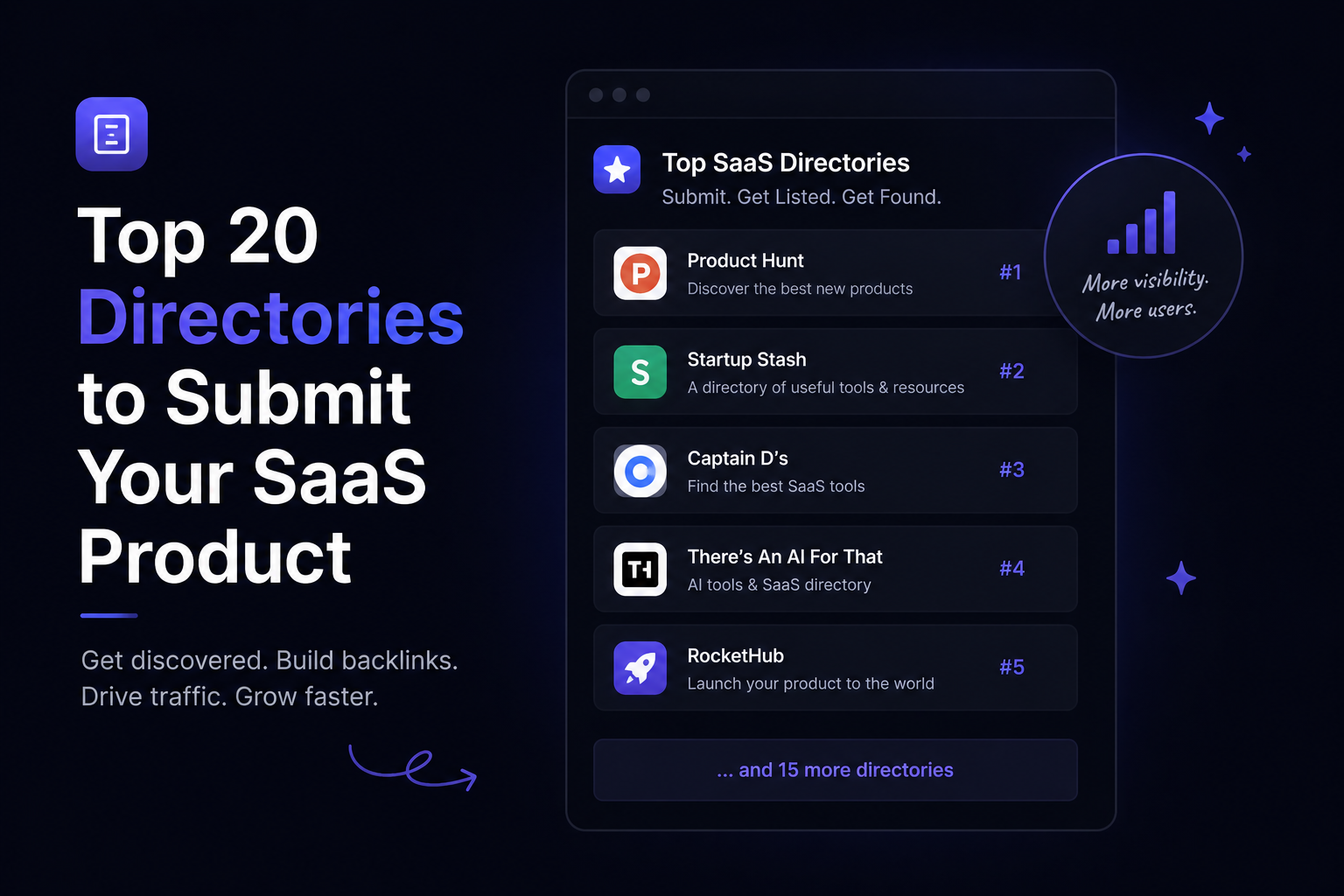
Top 20 Directories to Submit Your SaaS Product
Jul 17, 2026
Ahmed Errami
Introduction
Launching a great SaaS product is only the beginning.
No matter how useful your product is, it won't grow if people don't know it exists. That's why many successful founders submit their products to startup directories as one of their first marketing activities.
A good startup directory can help you:
Drive targeted traffic to your website
Earn valuable backlinks that improve SEO
Reach early adopters and potential customers
Increase your product's online visibility
Build credibility through listings and reviews
The best part?
Many of the most effective directories are completely free to submit.
That said, not all directories are worth your time.
Some have active communities that send consistent referral traffic, while others exist only to collect submissions and provide little value. Spending hours submitting your SaaS everywhere isn't a good growth strategy.
It's better to focus on a smaller number of high-quality directories that can genuinely help your product get discovered.
In this guide, we've curated 20 of the best startup directories for SaaS founders. For each directory, we'll explain what it's best for, whether it's free, how difficult it is to get listed, and share practical tips to increase your chances of success.
Whether you're launching your first SaaS or looking for new ways to promote an existing product, these directories can help you attract your first users, improve your SEO, and build momentum around your product.
Why Startup Directories Still Matter
With social media, SEO, and AI search becoming more competitive every year, you might wonder whether startup directories are still worth the effort.
The short answer is yes—if you choose the right ones.
You probably won't get thousands of customers from a single directory listing. But that's not the point.
The real value comes from the combination of benefits they provide.
1. They Help People Discover Your Product
Every day, founders, developers, investors, journalists, and early adopters browse startup directories looking for new products.
Being listed gives your SaaS another opportunity to be discovered by people actively interested in trying new software.
2. They Can Improve Your SEO
Many startup directories provide a profile page that links back to your website.
While not every backlink carries the same SEO value, high-quality directory listings can strengthen your backlink profile and make it easier for search engines to discover your product.
More importantly, your directory profile often ranks for branded searches, giving potential customers another way to find you.
3. They Build Credibility
When someone discovers a new SaaS, they often look for signals that it's legitimate.
Seeing your product listed on well-known platforms like Product Hunt, G2, or Capterra can increase trust, especially if your profile includes reviews, screenshots, and detailed product information.
4. They Continue Sending Traffic Over Time
Unlike a social media post that disappears after a day or two, a directory listing can continue bringing visitors months—or even years—after you publish it.
The amount of traffic varies by platform, but a well-written profile can become a consistent source of referral traffic over time.
Before You Submit Your SaaS
Before submitting your product to dozens of directories, spend a few minutes preparing your listing.
A complete, polished profile usually performs much better than one created in a hurry.
Here's a simple checklist:
✅ A clear one-sentence product description
✅ A memorable logo and product icon
✅ High-quality screenshots
✅ A short demo video or GIF (if supported)
✅ A compelling tagline
✅ Your website and pricing page
✅ Social media links
✅ Contact information
✅ Relevant product categories
✅ A unique description for each directory (avoid copying the same text everywhere)
Tip: Don't copy and paste the exact same description into every directory. Tailor it slightly for each platform to better match its audience and avoid creating dozens of identical listings across the web.
Top 20 Startup Directories to Submit Your SaaS
We've selected these directories based on their reputation, active communities, SEO value, and relevance for SaaS products. Rather than submitting to all of them in one day, focus on the ones that best match your target audience.
1. Product Hunt ⭐
Best for: Product launches and early adopters
Product Hunt is one of the most influential platforms for launching a new SaaS. A successful launch can bring thousands of visitors, valuable feedback, and long-term brand awareness.
Free: ✅ Yes
Backlink: ✅ Yes
Difficulty: ⭐⭐⭐⭐☆ High
Best for: New product launches
Tips
Launch on a weekday when your audience is active.
Prepare screenshots, a demo video, and a clear tagline.
Be available all day to answer questions and comments.
Ask existing customers to support your launch—but avoid spammy vote requests.
2. BetaList
Best for: Early-stage startups
BetaList helps founders showcase new startups to early adopters looking to try innovative products before they become mainstream.
Free: ✅ Yes
Backlink: ✅ Yes
Difficulty: ⭐⭐⭐☆☆ Medium
Best for: Pre-launch and recently launched products
Tips
Explain what makes your product different in one sentence.
Use high-quality screenshots.
Keep your description focused on the problem you solve.
3. Indie Hackers
Best for: Bootstrapped SaaS founders
Indie Hackers is more than a directory—it's one of the largest communities for founders building profitable internet businesses.
Products shared alongside genuine stories often receive far more engagement than simple promotional posts.
Free: ✅ Yes
Backlink: ✅ Yes
Difficulty: ⭐⭐☆☆☆ Low
Best for: Building an audience
Tips
Share your journey, not just your product.
Write about lessons learned and milestones.
Engage with other founders before promoting your SaaS.
4. Peerlist
Best for: Developers and makers
Peerlist has become a popular place for developers to showcase projects, startups, and portfolios.
It's especially valuable if your target audience includes engineers or technical founders.
Free: ✅ Yes
Backlink: ✅ Yes
Difficulty: ⭐⭐☆☆☆ Low
Tips
Add polished screenshots.
Keep your profile updated as your product evolves.
Encourage users to leave feedback.
5. SaaSHub
Best for: Long-term SEO and product discovery
SaaSHub is one of the largest software directories dedicated to SaaS products.
Many founders discover alternatives through SaaSHub, making it a valuable long-term traffic source.
Free: ✅ Yes
Backlink: ✅ Yes
Difficulty: ⭐⭐☆☆☆ Low
Tips
Choose accurate categories.
Keep your pricing updated.
Add multiple screenshots to improve your listing.
6. AlternativeTo
Best for: Products replacing existing software
AlternativeTo is widely used by people searching for alternatives to popular software.
If your SaaS competes with an established product, this platform can send highly targeted traffic.
Free: ✅ Yes
Backlink: ✅ Yes
Difficulty: ⭐⭐⭐☆☆ Medium
Tips
Clearly explain how your product differs from competitors.
Select relevant alternatives.
Keep feature information accurate.
7. G2
Best for: Building credibility through reviews
G2 is one of the most trusted software review platforms.
Although collecting reviews takes time, a strong G2 profile can significantly improve trust with potential customers.
Free: ✅ Basic listing
Backlink: ✅ Yes
Difficulty: ⭐⭐⭐⭐☆ High
Tips
Encourage satisfied customers to leave honest reviews.
Complete every section of your profile.
Keep screenshots and feature lists up to date.
8. Capterra
Best for: B2B SaaS products
Capterra is especially valuable for SaaS companies targeting businesses.
Many buyers compare software on Capterra before making purchasing decisions.
Free: ✅ Yes
Backlink: ✅ Yes
Difficulty: ⭐⭐⭐⭐☆ High
Tips
Invest time in collecting reviews.
Use clear product categories.
Respond professionally to customer feedback.
9. DevHunt
Best for: Developer tools and AI products
DevHunt is designed specifically for products built by developers.
It's an excellent launch platform for technical SaaS products, developer tools, APIs, and AI applications.
Free: ✅ Yes
Backlink: ✅ Yes
Difficulty: ⭐⭐☆☆☆ Low
10. Tiny Startups
Best for: Indie hackers and bootstrapped founders
Tiny Startups highlights independent businesses and small SaaS products that might otherwise struggle to gain visibility.
Free: ✅ Yes
Backlink: ✅ Yes
Difficulty: ⭐☆☆☆☆ Very Low
Tips
Tell your founder story.
Highlight what makes your SaaS unique.
Include clear screenshots and a concise description.
11. Microlaunch
Best for: Indie makers and micro SaaS launches
Microlaunch is built specifically for indie hackers and bootstrapped founders launching small software products. While it's smaller than Product Hunt, it's much less competitive and can be a great place to get your first users.
Free: ✅ Yes
Backlink: ✅ Yes
Difficulty: ⭐☆☆☆☆ Very Low
Tips
Launch with polished screenshots.
Clearly explain the problem your product solves.
Engage with other makers before promoting your own product.
12. Uneed
Best for: New SaaS and AI products
Uneed is a growing product discovery platform where founders can showcase startups, collect upvotes, and reach early adopters.
Free: ✅ Yes
Backlink: ✅ Yes
Difficulty: ⭐⭐☆☆☆ Low
Tips
Submit your product early in the day.
Keep your tagline short and memorable.
Share your listing with your community after launch.
13. Futurepedia
Best for: AI-powered SaaS
If your product uses AI, Futurepedia is one of the best directories for reaching users actively searching for AI tools.
Free: ✅ Yes (basic listing)
Backlink: ✅ Yes
Difficulty: ⭐⭐⭐☆☆ Medium
Tips
Clearly explain your AI use case.
Choose the most relevant categories.
Keep feature descriptions updated.
14. There's An AI For That
Best for: AI startups
One of the largest directories dedicated exclusively to AI products.
Many users browse it daily to discover new AI tools for work, productivity, and development.
Free: ✅ Yes
Backlink: ✅ Yes
Difficulty: ⭐⭐⭐☆☆ Medium
Tips
Use keywords your audience searches for.
Add multiple screenshots.
Keep your listing updated as new features are released.
15. AI Tools Directory
Best for: AI applications and productivity tools
Another popular platform for AI startups looking to increase visibility and attract early users.
Free: ✅ Yes
Backlink: ✅ Yes
Difficulty: ⭐⭐☆☆☆ Low
Tips
Focus on the outcomes your product delivers.
Include a strong call to action.
Refresh your profile regularly.
16. StartupBase
Best for: Startup exposure
StartupBase allows founders to showcase their products and makes it easier for potential customers, investors, and journalists to discover new startups.
Free: ✅ Yes
Backlink: ✅ Yes
Difficulty: ⭐⭐☆☆☆ Low
Tips
Write a concise product description.
Choose accurate categories.
Add a professional logo and screenshots.
17. Fazier
Best for: Product discovery
Fazier is a modern startup discovery platform where founders can submit new products and gain visibility within the startup community.
Free: ✅ Yes
Backlink: ✅ Yes
Difficulty: ⭐⭐☆☆☆ Low
Tips
Publish a complete profile.
Include your pricing information.
Share your listing after it's approved.
18. Startup Stash
Best for: Startup resources and tools
Startup Stash curates useful tools for entrepreneurs across dozens of categories, making it another valuable place to increase your product's visibility.
Free: ✅ Yes
Backlink: ✅ Yes
Difficulty: ⭐⭐☆☆☆ Low
Tips
Submit to the most relevant category.
Keep your description focused on the main benefit.
Include a recognizable logo.
19. Hacker News – Show HN
Best for: Technical founders and developers
While not a traditional directory, Show HN remains one of the best places to introduce new products to a highly technical audience.
A successful Show HN post can generate meaningful feedback, early users, and valuable discussions.
Free: ✅ Yes
Backlink: ✅ Yes
Difficulty: ⭐⭐⭐⭐☆ High
Tips
Focus on your story and what you built.
Be transparent about your journey.
Respond thoughtfully to comments and questions.
20. Reddit
Best for: Finding your first users
Reddit isn't a directory in the traditional sense, but many niche communities welcome founders who genuinely share products that solve real problems.
The key is to participate in relevant communities instead of dropping promotional links.
Free: ✅ Yes
Backlink: ❌ Usually No
Difficulty: ⭐⭐⭐☆☆ Medium
Tips
Share your experience, not just your product.
Contribute to discussions before promoting.
Find subreddits where your target customers already spend time.
Always follow each community's self-promotion rules.
A Smart Submission Strategy
One of the biggest mistakes founders make is submitting their SaaS to 20 directories in a single day.
It feels productive—but it's rarely the best approach.
Instead, spread your submissions over a few weeks and adapt your messaging to each platform. This gives you more time to engage with each community, respond to comments, and improve your listing based on feedback.
Here's a simple launch strategy you can follow:
Week 1: Launch Where Engagement Matters Most
Focus on platforms with active communities.
Product Hunt
Indie Hackers
Peerlist
Hacker News (Show HN)
Reddit (relevant communities)
These platforms can generate valuable feedback, early users, and conversations around your product.
Week 2: Build Your Long-Term Presence
Next, submit your product to software directories that can continue driving traffic over time.
SaaSHub
AlternativeTo
G2
Capterra
StartupBase
These listings often rank well in search engines and can become a steady source of referral traffic.
Week 3: Expand Your Reach
Finally, submit to niche and emerging directories.
BetaList
Microlaunch
Uneed
Futurepedia
AI directories (if applicable)
Tiny Startups
Fazier
At this stage, your product already has a polished landing page, better screenshots, and hopefully a few customer testimonials or reviews.
The result is stronger listings across every platform.
Common Mistakes to Avoid
Submitting your SaaS to directories is easy.
Getting meaningful results is harder.
Avoid these common mistakes.
Submitting Before Your Landing Page Is Ready
Your directory listing brings visitors to your website.
If your landing page doesn't clearly explain what your product does, visitors will leave without signing up.
Before promoting your SaaS, make sure you have:
A clear headline
Product screenshots
Pricing information
A simple call to action
Fast loading pages
Mobile-friendly design
Using the Same Description Everywhere
Copying and pasting the exact same description into every directory is tempting, but it isn't ideal.
Customize your description slightly for each platform.
Different audiences care about different things.
For example:
Developers may care about integrations.
Product managers may care about collaboration.
Founders may care about pricing and ease of use.
Tailoring your messaging makes your listing feel more authentic.
Ignoring Reviews and Comments
Directories aren't just places to publish your product.
They're places to have conversations.
If users ask questions, leave reviews, or provide feedback, take the time to respond.
Active founders often build more trust than inactive ones.
Chasing Quantity Over Quality
You don't need to submit to 200 directories.
In fact, most founders will see better results by focusing on 15–20 reputable platforms than hundreds of low-quality sites.
Quality listings on trusted websites are far more valuable than dozens of listings that never receive visitors.
Never Updating Your Listings
Your product will evolve over time.
Your directory profiles should evolve with it.
Every few months, review your listings and update:
Screenshots
Product descriptions
Pricing
Features
Website links
Branding
An up-to-date profile builds trust and gives visitors an accurate picture of your product.
Conclusion
Submitting your SaaS to startup directories won't make your product an overnight success—but it can give you the visibility needed to reach your first customers, earn valuable backlinks, and build momentum.
The key is to focus on quality over quantity.
Choose directories with active communities, create thoughtful listings, and engage with the people who discover your product. Over time, those small efforts can compound into better SEO, more referral traffic, and stronger brand recognition.
Remember, a directory listing is just the beginning.
The products that continue to grow are the ones that keep shipping, improving, and communicating with their users.
Launch Your SaaS With Confidence
After people discover your product, they'll want to know one thing:
Is this product actively improving?
A public changelog helps answer that question.
With Announcify, you can publish beautiful release notes, embed an in-app changelog widget, and keep customers informed every time you ship a new feature.
Launch your product. Keep shipping. Let your progress speak for itself.
Ahmed Errami
I'm a full stack developer who is passionate about building products that help people. I'm also the founder of Announcify.
Product Updates
Sep 5, 20268 min read
Best AI Release Notes Generators
Manually writing release notes after every deployment takes time. Here are the best AI release notes generators for turning your development workflow into clear, customer-friendly product updates.
 Ahmed Errami