How Often Should You Ship New Features? | Announcify
Product Updates8 min read
How Often Should You Ship New Features?
Aug 17, 2026
Ahmed Errami
Introduction
Shipping new features is one of the clearest ways a SaaS company shows that its product is improving.
But how often should you actually ship?
Should you release a new feature every week? Every two weeks? Once a month?
There isn't a universal answer.
Shipping too slowly can make your product feel stagnant. Shipping too quickly can lead to rushed features, technical debt, bugs, and a product that's increasingly difficult for customers to use.
The goal isn't to ship as many features as possible.
The goal is to ship valuable improvements at a pace your team can maintain.
In this guide, we'll look at how often SaaS companies should ship new features, what should determine your release cadence, how to avoid shipping for the sake of shipping, and how to keep customers informed as your product evolves.
Because the best release schedule isn't the one that produces the most features.
It's the one that consistently delivers real value to customers.
How Often Should SaaS Companies Ship New Features?
There is no universal release schedule that works for every SaaS company.
A small startup with two developers may be able to ship improvements every week, while a larger SaaS company may need several weeks or months to release a major feature.
For many SaaS teams, a good starting point is to aim for meaningful product improvements every 1–4 weeks.
That doesn't mean you need to launch a major feature every week.
Your releases can include:
New features
Smaller product improvements
Customer-requested changes
New integrations
Performance improvements
UX improvements
Bug fixes
The important part is that customers regularly see useful progress.
Weekly Releases
A weekly release cadence can work well for early-stage SaaS companies and small teams.
You're still learning what customers want, so shipping frequently gives you more opportunities to collect feedback and adjust the product.
But weekly doesn't mean one major feature every week.
You might ship a small improvement one week, a bug fix the next, and a larger feature a few weeks later.
The advantage of weekly shipping is the speed of the feedback loop:
Build → release → learn → improve.
The risk is turning the schedule into a target that must be hit regardless of whether there's anything meaningful to ship.
Biweekly Releases
A two-week release cycle can provide a good balance between speed and quality.
Your team gets more time to:
Build the feature
Test it
Fix problems
Prepare documentation
Collect internal feedback
Prepare customer communication
It also gives you enough time to group several smaller improvements into a meaningful product update.
For many growing SaaS products, a biweekly cadence can be a practical starting point.
Monthly Releases
Monthly releases make sense when features require more planning and development time.
This is particularly common when you're building complex functionality, working with a small team, or serving customers who value stability.
Instead of releasing something every week, you can spend several weeks building and testing a larger improvement.
The important thing is to avoid going silent between releases.
Even if major features take a month to build, you can still communicate smaller improvements, bug fixes, and other product changes through your changelog.
There Is No Need to Choose One Schedule Forever
Your release cadence can change as your company grows.
An early-stage SaaS might ship multiple times per week while validating its product.
As the product becomes more complex, releases might become less frequent because each change requires more testing, documentation, and coordination.
That's normal.
Your release schedule should evolve with your team, product, and customers.
The goal isn't to maintain a specific number of releases.
It's to find a cadence that lets you move quickly without sacrificing quality or customer value.
What Should Determine Your Feature Release Cadence?
The right release cadence depends on more than how quickly your development team can write code.
Several factors should influence how often you ship new features.
Team Size
Your team determines how much development work you can realistically handle.
A small team may be able to move quickly because there are fewer people involved in decisions and coordination.
However, that doesn't mean a small team should constantly ship.
Limited resources also mean you need to be careful about spreading your development effort across too many features.
Choose a cadence your team can maintain without constantly working under pressure.
Feature Complexity
Not every feature takes the same amount of time.
A small UI improvement might take a few hours.
A new billing system, API, or collaboration workflow could require weeks of development and testing.
Your release cadence should account for this difference.
Don't delay a small improvement just because you're following a monthly schedule, and don't rush a complex feature simply because you promised a weekly release.
Product Maturity
Your ideal shipping frequency will usually change as your SaaS grows.
An early-stage product often benefits from shipping quickly because you're still trying to discover what customers actually need.
Later, the product becomes more complex.
You may need to consider:
Backwards compatibility
Existing customer workflows
Performance
Security
Documentation
Support
Technical debt
As these requirements increase, your team may need more time between major releases.
Customer Expectations
Your customers should also influence your release cadence.
Some customers love frequent updates and want to see the product improving every week.
Others care more about stability and predictability.
If your product is deeply integrated into a customer's workflow, unexpected changes can create problems.
Pay attention to customer feedback and support requests to understand what your audience actually expects.
Development Quality
Speed shouldn't come at the expense of quality.
If your team is regularly shipping bugs because you're trying to maintain a specific release schedule, the schedule is too aggressive.
A feature that takes three weeks to build and works reliably is more valuable than three rushed features that create support tickets and frustrate customers.
Your release cadence should give your team enough time to:
Test features properly
Fix bugs
Review edge cases
Update documentation
Prepare customers for important changes
Your Ability to Support New Features
Shipping a feature creates ongoing work.
Someone has to maintain it, document it, answer questions about it, fix bugs, and eventually improve it.
Before adding another feature, consider the long-term cost.
A product with 20 well-maintained features can be easier to manage than a product with 100 features that customers barely use.
Customer Demand
Customer requests can also help determine what you should ship next.
If multiple customers are asking for the same improvement, that may be a stronger signal than an arbitrary roadmap deadline.
However, don't turn every customer request into a feature.
Look for patterns.
The best roadmap decisions usually combine customer feedback with product data, business goals, and your own product vision.
Your Release Cadence Should Be Sustainable
The best cadence is not necessarily the fastest one.
It's the fastest pace your team can maintain while continuing to build useful, reliable features.
If your current schedule constantly feels rushed, slow down.
If your team has capacity and customers are asking for improvements, you may be able to increase your release frequency.
The right cadence is the one that keeps development speed, product quality, and customer value in balance.
Don't Confuse Shipping With Launching
One reason SaaS teams feel pressured to ship constantly is that they treat shipping and launching as the same thing.
They're not.
Shipping Is a Product Event
Shipping simply means that a change is available in your product.
You might deploy:
A new feature
A bug fix
A performance improvement
A small UI change
A new integration
Some of these changes may be important enough to communicate to customers. Others aren't.
Launching Is a Customer Communication Event
A launch is everything you do to help customers discover and understand an important new feature.
It might include:
An email announcement
An in-app announcement
A changelog entry
Documentation
A tutorial
Social media posts
Customer outreach
This distinction gives you much more flexibility with your release cadence.
You can ship multiple times per week without sending customers multiple emails every week.
Your Changelog Can Handle Frequent Releases
If your team ships frequently, your changelog can become the central place where customers see what's new.
You can document:
Small improvements
Bug fixes
New features
Performance updates
Integrations
Customer-requested changes
Customers who want to follow every update can check the changelog.
Everyone else can continue using your product without receiving constant notifications.
Save Major Announcements for Major Releases
Not every release deserves the same amount of attention.
For example:
Update
Ship
Changelog
Email
Major new feature
Yes
Yes
Yes
New integration
Yes
Yes
Usually
Customer-requested improvement
Yes
Yes
Sometimes
Performance improvement
Yes
Yes
Sometimes
Bug fix
Yes
Usually
Usually no
Small UI change
Yes
Optional
No
This approach allows your development team to move quickly while keeping customer communication focused.
A Faster Shipping Cadence Doesn't Mean More Customer Emails
You could ship something every week and still send only two or three product update emails per month.
The difference is that your development cadence and communication cadence don't have to be identical.
That's an important distinction for SaaS teams.
Your developers should be able to ship when something is ready.
Your marketing and customer communication should determine which updates deserve broader attention.
This allows you to move quickly without overwhelming customers.
Ship Often, Communicate Intentionally
Frequent shipping is valuable when it helps you learn faster and deliver more customer value.
But customers don't need to hear about every deployment.
Ship based on development readiness.
Launch based on customer value.
Document everything important in your changelog.
That gives your team the freedom to move quickly without turning every release into an announcement.
Should You Ship Features Every Week?
Weekly shipping can be a great strategy for some SaaS companies, but it shouldn't become a goal by itself.
The real benefit of shipping every week isn't the number of features you release.
It's the speed of your feedback loop.
When you ship frequently, you can learn from real customers sooner.
The Feedback Loop
A fast product development cycle can look like this:
Build → Ship → Measure → Learn → Improve
Instead of spending three months building a feature based entirely on assumptions, you can release a smaller version, observe how customers use it, and improve it based on real feedback.
This is particularly useful for early-stage SaaS products.
When Weekly Shipping Makes Sense
Weekly releases can work well when:
Your team is small and moves quickly
Features are relatively small
You have fast customer feedback
You're still validating your product
Your deployment process is reliable
Your team can maintain quality
In this environment, frequent releases can help you discover what customers actually want.
When Weekly Shipping Becomes a Problem
Weekly shipping can become counterproductive when your team starts building features simply to maintain the schedule.
For example, imagine your team has nothing meaningful ready this week.
Instead of waiting, you decide to add a small feature just so you can say:
"We shipped something this week."
That's when the release cadence starts controlling your roadmap instead of the other way around.
Other warning signs include:
Increasing bugs
Growing technical debt
Features receiving little adoption
Developers feeling constantly rushed
Customers struggling to keep up with changes
More support requests after releases
If you start seeing these patterns, it's worth slowing down.
Weekly Doesn't Mean Major Feature Every Week
This is an important distinction.
A weekly shipping cadence can include small improvements, fixes, and experiments.
For example:
Week 1: New integration
Week 2: Search improvements
Week 3: Bug fixes and performance improvements
Week 4: New dashboard
You've maintained a weekly shipping rhythm without forcing your team to produce four major features every month.
Use Weekly Shipping to Learn Faster
If you decide to ship weekly, treat it as a learning system rather than a productivity score.
Ask after every release:
Did customers use it?
Did they understand it?
Did it solve the problem we expected?
What feedback did we receive?
What should we change next?
The faster you can answer these questions, the faster you can improve your product.
The Goal Is Learning, Not Shipping
Shipping frequently is useful when it helps you get closer to product-market fit and deliver better experiences.
But shipping more features isn't automatically better.
If slowing down gives your team more time to understand a customer problem and build the right solution, slowing down can actually make you faster in the long run.
How to Avoid Shipping Too Many Features
Shipping frequently can be a competitive advantage, but more features don't automatically make a better SaaS product.
Every feature you add creates additional complexity.
Someone has to maintain it, test it, document it, support it, and eventually improve it.
If you keep adding features without evaluating their value, your product can become harder to use and harder to maintain.
Focus on Problems, Not Feature Ideas
Before adding something to your roadmap, ask:
What customer problem does this solve?
If you can't clearly explain the problem, the feature probably needs more validation.
A feature should exist because it helps customers accomplish something—not simply because it sounds interesting.
Look for Evidence Before Building
Feature requests, support conversations, customer interviews, and product analytics can all help you decide what deserves development time.
Look for patterns.
If one customer asks for a feature once, that doesn't necessarily mean you should build it.
If 20 customers repeatedly struggle with the same problem, that's a much stronger signal.
You can also look at:
How frequently the problem occurs
How many customers experience it
How customers currently solve it
How much time the problem costs them
Whether solving it could improve retention or revenue
Consider the Cost of Complexity
Every feature adds another part of your product that customers need to understand.
More features can mean:
More UI elements
More settings
More documentation
More support questions
More edge cases
More testing
More maintenance
This is why feature count isn't a useful measure of product quality by itself.
Sometimes the best product decision is to not build a feature.
Remove Features That Don't Create Value
Your roadmap shouldn't only answer:
"What should we build next?"
It should also answer:
"What should we stop maintaining?"
Look at features that have very low usage or no longer solve an important problem.
Depending on the situation, you might:
Improve the feature
Make it easier to discover
Merge it with another feature
Deprecate it
Remove it
Removing unnecessary functionality can make the product easier to understand and maintain.
Don't Build Just to Keep Up With Competitors
Seeing a competitor launch a feature can create pressure to build the same thing.
But your customers may not need it.
Before copying a competitor, ask:
Are our customers asking for this?
Does it solve an important problem for our audience?
Does it fit our product strategy?
If the answer is no, spending months building it may simply add complexity without creating meaningful value.
Fewer Features Can Mean a Better Product
A SaaS product doesn't need to constantly grow in every direction.
It needs to become more useful.
One well-designed feature that solves a major customer problem can be more valuable than ten small features that nobody uses.
That's why your release cadence should always be connected to customer value.
Ship often when it helps customers. Slow down when you need to build the right thing.
How to Keep Customers Updated as You Ship
The faster you ship, the more important product communication becomes.
Customers won't automatically notice every improvement you make. Even if you're releasing useful features every week, many customers may never discover them unless you tell them.
But that doesn't mean you should email customers every time you deploy something.
The key is to separate shipping frequency from communication frequency.
Use a Changelog for Frequent Updates
Your changelog can be the central place where customers see what's new.
Document meaningful changes such as:
New features
Improvements
Integrations
Performance updates
Customer-requested changes
Important bug fixes
This allows you to keep a complete history of your product without sending an email for every release.
Use Email for Important Features
Email is better suited for updates that deserve immediate attention.
For example:
A major new feature
A new integration
A significant workflow change
A feature customers have been requesting
An important product change
You can group several smaller updates into a single product update email instead of sending multiple messages throughout the week.
Use In-App Announcements
In-app announcements are useful because customers see them while they're already using your product.
This can be particularly effective for features that require customers to take action.
For example:
You can now automate your reports
Connect your account and create your first automated report.
The customer can discover the feature and immediately try it.
Make Product Updates Easy to Discover
Don't rely on a single announcement.
A customer might miss your email or not log in on the day you publish the feature.
Make important updates discoverable through:
Your changelog
In-app announcements
Documentation
Product onboarding
Help center articles
Your website
Social media
This creates multiple opportunities for customers to discover what you've built.
Connect Updates to Customer Value
Avoid turning your product updates into a list of technical changes.
Instead of:
"Added bulk editing to the dashboard."
Try:
"Update hundreds of records at once instead of editing them individually."
The second version immediately explains the benefit.
Customers don't need to understand what your development team changed.
They need to understand what they can now do.
Frequent Shipping Requires Better Communication, Not More Communication
A team that ships frequently doesn't need to communicate every release through every channel.
Instead:
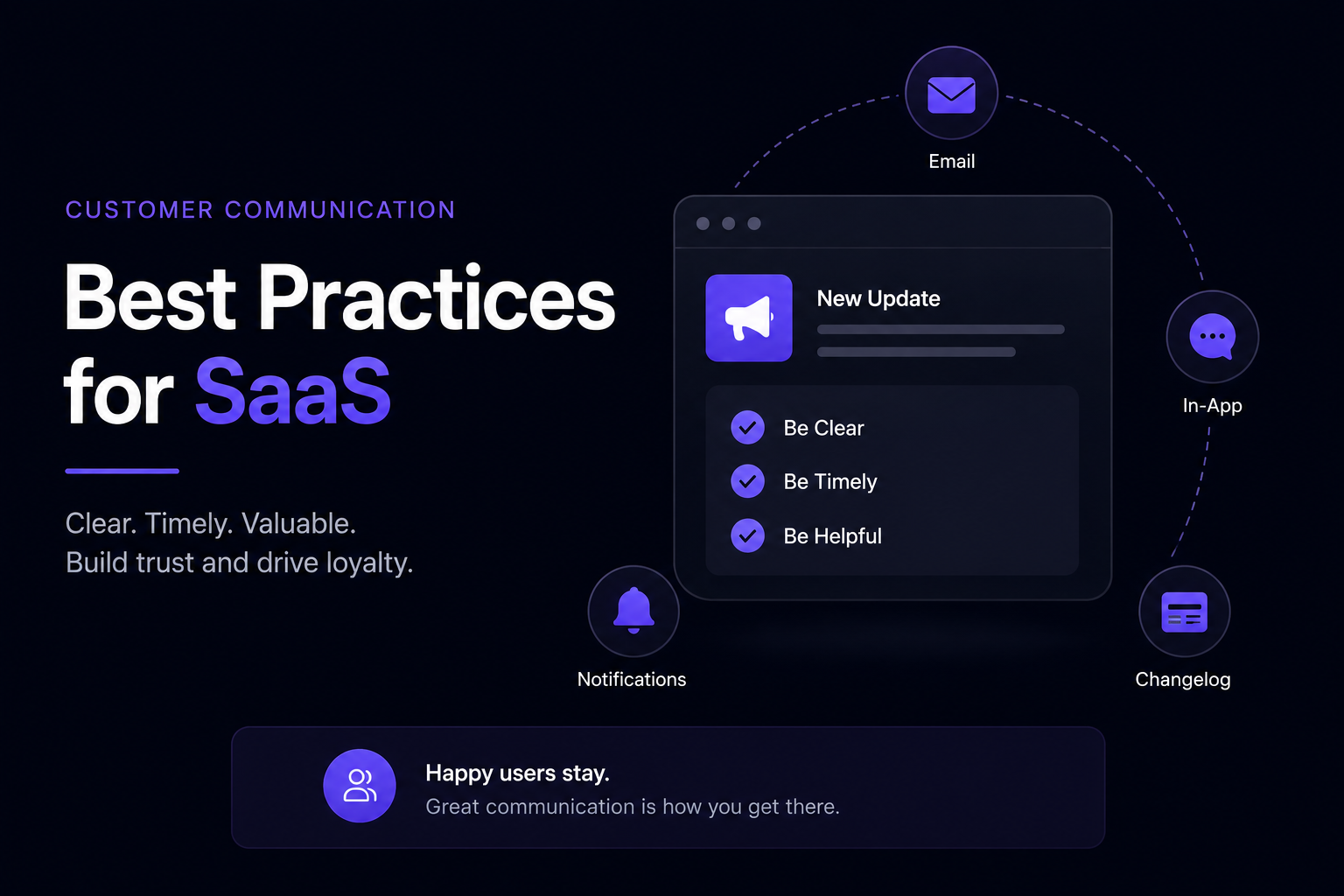
Changelog: Keep the complete product history.
In-app announcements: Highlight relevant updates to active users.
Email: Announce major features and important changes.
Documentation: Explain how complex features work.
This lets your team ship frequently while keeping customer communication focused and useful.
A Practical SaaS Release Cadence
If you're still unsure how often to ship, start with a simple cadence and adjust it based on your team's capacity and customer feedback.
You don't need a complicated release process.
Every Week
Focus on shipping small improvements when they're ready.
This can include:
Bug fixes
Small UX improvements
Performance improvements
Minor customer requests
Small experiments
Don't force a feature into every weekly release.
If there's nothing meaningful to ship, it's fine to wait.
Every 2–4 Weeks
Aim to deliver a more meaningful product improvement.
This could be:
A new feature
A major improvement
A new integration
A customer-requested capability
These releases are also good candidates for customer-facing communication.
Every Quarter
Take a step back and review your product development.
Look at:
What you shipped
What customers actually adopted
Which features created the most value
Which releases caused problems
Which customer requests keep appearing
What should be built next
This prevents your roadmap from becoming a never-ending list of feature requests.
Adjust Based on Your Product
This cadence is only a starting point.
You might find that weekly releases are too slow for your early-stage SaaS.
Or you might discover that your growing product needs more time between major releases.
That's completely normal.
The right cadence is the one that fits your current stage.
A Simple Rule for SaaS Founders
If you want a simple framework, use this:
Ship small improvements continuously.
Ship meaningful features every few weeks.
Review your roadmap every quarter.
Never ship something just to hit a number.
This gives you enough consistency to keep the product moving forward without turning your release schedule into a source of unnecessary pressure.
Frequently Asked Questions
How often should a SaaS company release new features?
There is no universal schedule, but many SaaS companies can aim to ship meaningful improvements every 1–4 weeks.
The exact cadence depends on team size, feature complexity, product maturity, customer expectations, and development quality.
The important thing is to choose a schedule your team can maintain.
Is it better to ship features every week?
Not necessarily.
Weekly shipping can help early-stage SaaS companies learn quickly and respond to customer feedback, but it can also encourage teams to rush low-value features just to maintain the schedule.
Ship weekly when it helps you learn and deliver value, not simply because you want to hit a release target.
How many features should a SaaS company release each month?
There's no ideal number.
A company might release several small improvements and one major feature in a month, while another company might spend the entire month working on one complex feature.
Feature quality and customer adoption matter more than feature count.
Should SaaS companies release features continuously?
Continuous delivery can be useful because it allows teams to release improvements whenever they're ready.
However, continuous shipping doesn't mean customers need to be notified about every change.
Use a changelog to document updates and reserve email or major announcements for features that deserve customers' attention.
How do I know if I'm shipping features too quickly?
Some warning signs include:
Increasing bugs
More customer complaints
Growing technical debt
Features receiving little adoption
Developers feeling constantly rushed
Customers struggling to keep up with changes
Increasing support requests after releases
If these problems become common, your release cadence may be too aggressive.
How do I know if I'm shipping features too slowly?
You may be moving too slowly if:
Customers repeatedly request the same improvements
Important problems remain unsolved for months
Competitors are consistently solving problems your customers have
Your product isn't improving based on customer feedback
Your team has significant unused development capacity
However, slow shipping isn't always a problem. Sometimes a complex feature simply requires more time to build correctly.
Should every feature be announced to customers?
No.
Major features, important integrations, and customer-requested improvements are usually worth announcing.
Small UI changes, minor bug fixes, and other low-impact updates can simply be added to your changelog.
Does shipping more features increase SaaS growth?
Not automatically.
More features can help growth when they solve important customer problems, improve activation, increase retention, or create opportunities for expansion.
But shipping features that customers don't use can increase product complexity without creating meaningful value.
What's more important: shipping speed or product quality?
You need both, but quality should not be sacrificed just to increase shipping speed.
A sustainable release cadence allows your team to move quickly while still giving features enough time for testing, feedback, and refinement.
How can I keep customers informed if I ship frequently?
Use different channels for different types of updates.
A changelog can document your product's release history, while email can highlight major features and in-app announcements can surface relevant updates to active users.
This allows you to ship frequently without overwhelming customers with notifications.
Conclusion
There is no magic number of features a SaaS company should ship every month.
Some teams can release meaningful improvements every week. Others may need several weeks to properly build, test, and launch a major feature.
What matters is finding a cadence your team can maintain while keeping quality high and customers at the center of your product decisions.
A good approach is to:
Ship small improvements when they're ready
Release meaningful features every few weeks
Measure adoption instead of focusing only on feature count
Use customer feedback to guide your roadmap
Slow down when quality starts suffering
Keep customers informed through your changelog and other communication channels
Most importantly, don't ship just to say you shipped.
A feature only creates value when customers discover it, use it, and find it useful.
Keep Customers Updated as You Ship
Announcify helps SaaS teams communicate product updates without turning every release into another manual task.
Create a public changelog, announce new features with an in-app changelog widget, generate customer-friendly release notes with AI, and connect tools like GitHub and Linear to keep your customers informed as your product evolves.
You can ship frequently while keeping your communication focused.
Build continuously. Ship thoughtfully. Keep customers in the loop.
Ahmed Errami
I'm a full stack developer who is passionate about building products that help people. I'm also the founder of Announcify.
Product Updates
Sep 5, 20268 min read
Best AI Release Notes Generators
Manually writing release notes after every deployment takes time. Here are the best AI release notes generators for turning your development workflow into clear, customer-friendly product updates.
 Ahmed Errami