10 Feature Launch Mistakes SaaS Founders Make | Announcify
Product Launch6 min read
10 Feature Launch Mistakes SaaS Founders Make
Aug 6, 2026
Ahmed Errami
Introduction
Shipping a new feature is exciting.
After weeks or even months of planning, designing, coding, and testing, you're finally ready to put your work in front of customers.
But here's the hard truth:
Building a great feature doesn't guarantee anyone will use it.
Many SaaS founders spend countless hours developing new functionality, only to see little adoption after launch. Not because the feature isn't useful, but because the launch itself falls short.
Maybe the announcement didn't clearly explain the value. Maybe customers never discovered the feature. Or perhaps the team moved on to the next project before giving the launch enough attention.
Launching a feature is about much more than clicking the "Deploy" button.
It's about helping customers understand what's new, why it matters, and how it improves their experience.
The good news is that most unsuccessful launches fail for the same reasons. Once you recognize these common mistakes, they're surprisingly easy to avoid.
In this guide, we'll look at ten of the most common feature launch mistakes SaaS founders make, explain why they hurt adoption, and show you practical ways to make every release more successful.
Because a successful launch isn't measured by the day you ship.
It's measured by how many customers actually use what you've built.
Most feature launches don't fail because the feature is bad.
They fail because customers never fully understand its value.
Founders often assume that once a feature is live, people will naturally discover it and start using it. In reality, customers are busy. They're focused on their own work, not constantly checking your product for new functionality.
Without a clear launch strategy, even valuable features can go unnoticed.
Here are some of the most common reasons feature launches underperform:
Customers don't know the feature exists.
The announcement focuses on what changed instead of why it matters.
The feature is announced once and never mentioned again.
There's no clear onboarding or explanation.
Success isn't measured after launch.
The result is disappointing feature adoption.
Founders may conclude that customers didn't want the feature, when the real problem was that customers never had a chance to understand or discover it.
A successful feature launch doesn't end when the code reaches production.
That's when the real work begins.
Your goal is to help customers answer three simple questions:
What's new?
Why should I care?
How do I start using it?
If your launch clearly answers those questions, you're already ahead of many SaaS companies.
The next ten mistakes are the ones that most often prevent feature launches from reaching their full potential and, more importantly, how you can avoid them.
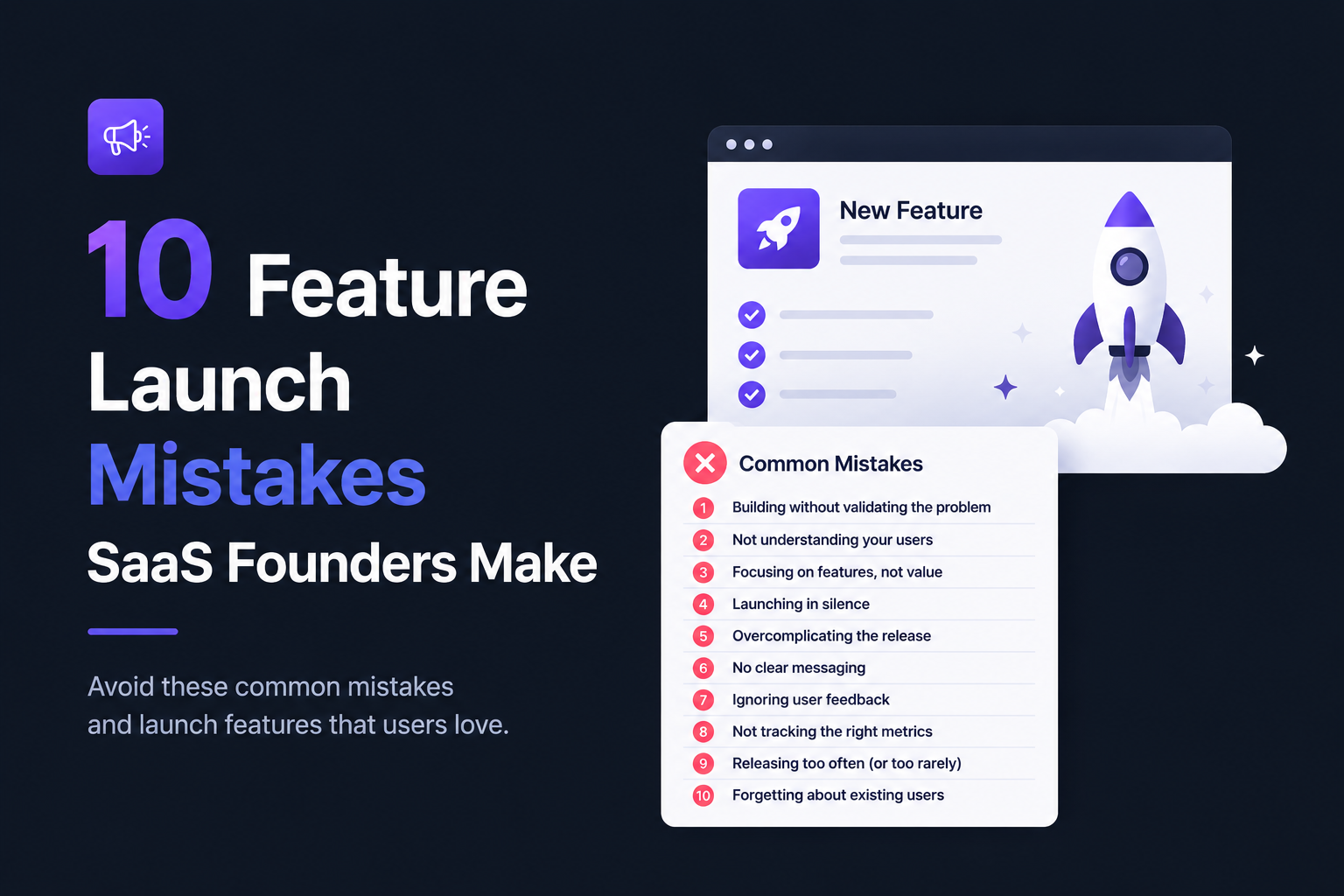
10 Feature Launch Mistakes SaaS Founders Make
A good feature launch needs more than a working feature and an announcement.
From deciding what to build to measuring adoption after release, every stage affects whether customers actually use what you've created.
Here are ten mistakes that can limit the impact of a feature launch.
1. Building Before Validating
One of the most expensive mistakes is spending months building something before confirming that customers actually need it.
It's easy to fall in love with an idea because it sounds useful.
But useful doesn't always mean necessary.
Before committing significant development time, look for evidence that the problem exists.
You can:
Talk to existing customers.
Review support requests.
Look at feature requests.
Interview potential users.
Create a simple prototype.
Ask customers how they're currently solving the problem.
Pay particular attention to repeated problems rather than isolated requests.
If several customers are struggling with the same problem, that's a much stronger signal than one person asking for a specific solution.
Validation doesn't guarantee success, but it reduces the risk of spending months building something customers don't care about.
2. Launching Without a Communication Plan
You probably have a development plan for your feature.
But do you have a plan for telling people about it?
Too often, communication becomes an afterthought.
The feature goes live, someone publishes a quick social media post, an email gets sent, and the team considers the launch finished.
Instead, decide how you'll communicate the feature before it's released.
Your launch plan might include:
A changelog announcement
An in-app notification
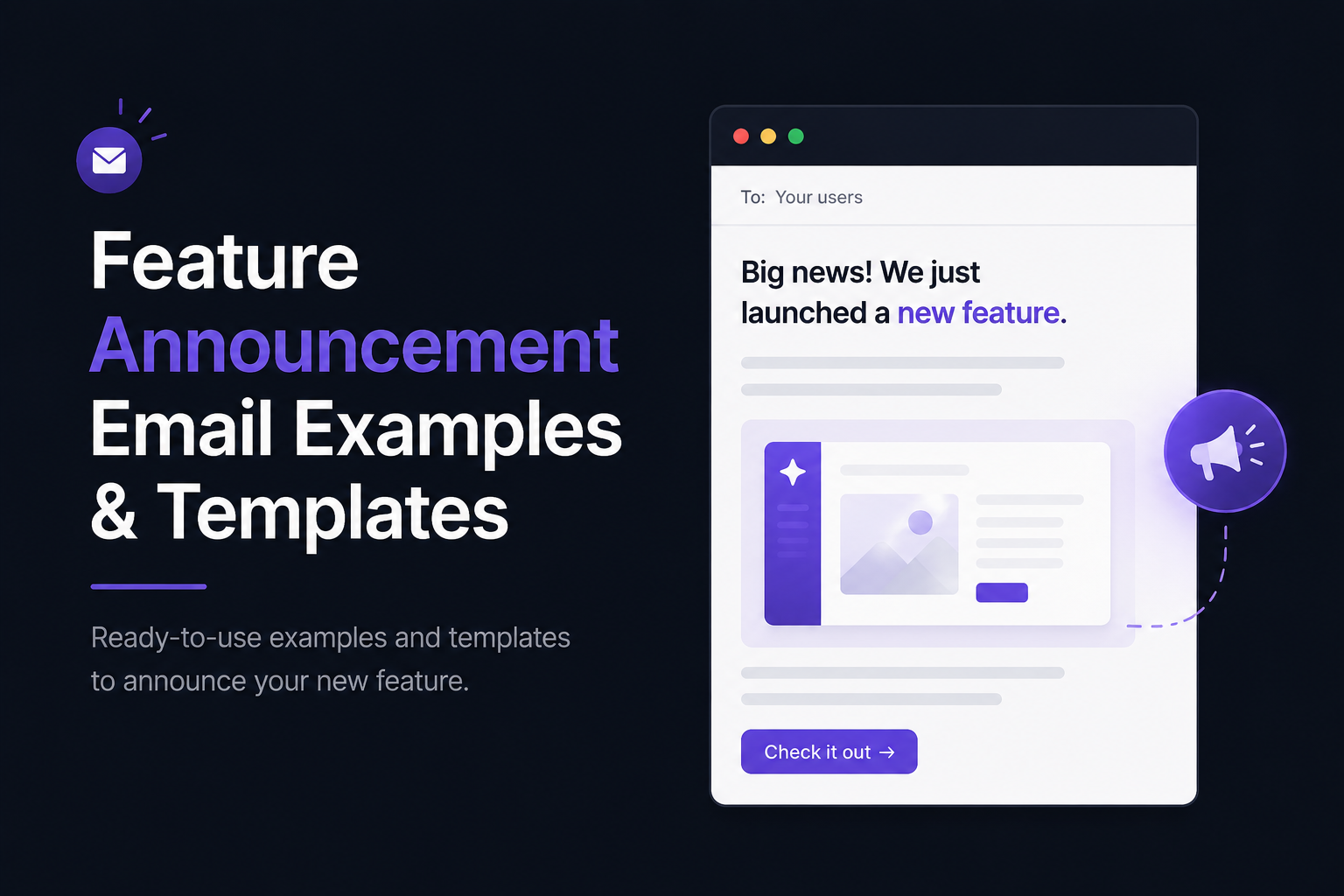
An email to existing customers
A blog post
Social media posts
Updated documentation
You don't necessarily need every channel for every feature.
The important thing is deciding where and how you'll communicate before launch day arrives.
3. Focusing on Features Instead of Benefits
Consider this announcement:
"We've added advanced filtering."
It's clear, but it doesn't give customers much reason to care.
Now compare it with:
"You can now find exactly what you're looking for without scrolling through hundreds of results."
The feature hasn't changed.
The framing has.
Your customers don't care about features simply because they're new. They care about what those features allow them to accomplish.
When writing your announcement, don't stop at:
"What did we build?"
Answer:
"What can customers do now that they couldn't do before?"
That's the message your launch should emphasize.
4. Announcing the Feature Only Once
You publish your announcement on Monday.
What happens to the customer who doesn't log in until Friday?
Or the person who misses your email?
Or someone who signs up two weeks later?
They may never know the feature exists.
This is why a feature launch shouldn't be treated as a single event.
Instead, communicate important features several times across different channels.
For example:
Launch day: Publish your changelog and in-app announcement.
A few days later: Send an email highlighting the main benefit.
The following week: Share a practical use case on social media.
Later: Mention the feature when it's relevant in tutorials, documentation, and other content.
You're not repeating the exact same announcement.
You're giving customers multiple opportunities to discover something useful.
5. Forgetting About Existing Customers
Feature launches often focus heavily on attracting new users.
Landing pages get updated. Social posts are scheduled. Launch platforms are prepared.
Meanwhile, the people already paying for the product receive very little communication.
That's backwards.
Existing customers should be among the first people to hear about meaningful improvements.
They're already invested in your product, understand the problem you're solving, and are often the most likely people to adopt the new feature.
More importantly, showing customers that the product continues to improve reinforces the value of their subscription.
Don't treat product updates purely as acquisition opportunities.
They're also retention opportunities.
6. Ignoring Feedback After Launch
Launching isn't the end of product development.
It's when you finally get to see how customers interact with what you've built.
Pay attention to:
Support conversations
Customer questions
Feature requests
Confusing workflows
Unexpected use cases
Adoption patterns
You might discover that customers want something slightly different from what you expected.
That's valuable information.
Use it to improve the feature rather than immediately moving on to the next item on your roadmap.
7. Shipping Too Many Features at Once
A large release can feel impressive.
But announcing ten features simultaneously creates another problem:
None of them gets enough attention.
Customers have limited time and attention. Giving them a long list of changes makes it difficult to understand which improvements actually matter to them.
When possible, give significant features room to breathe.
Instead of one massive announcement covering everything you've shipped during the last three months, consider publishing several focused updates.
Each feature gets a clearer message, and customers have more opportunities to discover what's new.
8. Forgetting to Measure Feature Adoption
Your feature has launched.
Your announcement received some clicks.
Was the launch successful?
You won't know unless you measure what happens next.
Depending on the feature, useful metrics might include:
Percentage of customers who tried the feature
Repeat usage
Activation rate
Engagement after adoption
Conversion to paid plans
Retention among users who adopted it
Don't measure success based purely on announcement views or social media engagement.
The real question is whether customers are using the feature and getting value from it.
9. Not Repurposing the Launch Into Content
You've already done the difficult work of building something worth talking about.
Don't waste that opportunity on a single announcement.
One feature launch can become:
A changelog entry
A launch email
A blog post
A short tutorial
A product demo
Several social media posts
A customer use case
Documentation
The content doesn't need to say the same thing every time.
One post might explain why you built the feature.
Another could demonstrate how to use it.
Another might explain the problem it solves.
Instead of constantly searching for things to talk about, use your product development itself as a source of content.
10. Not Maintaining a Public Changelog
After launch week ends, your announcement shouldn't disappear.
A public changelog gives every release a permanent home.
Customers who missed the original announcement can catch up later, while potential customers can browse your previous releases and see how actively the product is being developed.
Over time, your changelog becomes a record of your progress.
Instead of telling people that you're continuously improving your product, you can show them.
And unlike an email or social media post that quickly disappears from view, your changelog remains available whenever someone wants to see what's changed.
For SaaS founders shipping regularly, that makes it one of the simplest ways to extend the life of every feature launch.
Feature Launch Checklist
A successful launch starts long before you click "Deploy."
Use this checklist before every release to make sure you've covered the essentials.
Before Development
Understand the problem you're solving.
Validate the idea with customers or user feedback.
Define what success looks like.
Decide how you'll measure feature adoption.
Before Launch
Write clear, customer-focused release notes.
Prepare a public changelog entry.
Update your documentation or help center.
Create an in-app announcement if appropriate.
Draft an email for major features.
Prepare social media posts.
Test the feature thoroughly.
After Launch
Monitor feature adoption.
Collect customer feedback.
Answer questions from users.
Fix issues quickly.
Continue mentioning the feature in relevant content.
Update future onboarding and tutorials if the feature changes existing workflows.
Remember: Launch Day Is Just the Beginning
Many founders think of launch day as the finish line.
In reality, it's the starting point.
The days and weeks after release are when customers begin discovering, trying, and evaluating your feature.
That's why the most successful SaaS teams don't stop communicating after launch day.
They continue educating users, collecting feedback, measuring adoption, and improving the feature based on real-world usage.
A well-executed launch doesn't end with an announcement.
It ends when customers successfully adopt the feature and make it part of their workflow.
Frequently Asked Questions
What is a feature launch?
A feature launch is the process of introducing a new feature to your customers. It involves more than releasing code—it also includes communicating the update, educating users, collecting feedback, and measuring adoption after launch.
Why do feature launches fail?
Most feature launches fail because customers never discover or understand the new feature.
Common reasons include poor communication, unclear messaging, a lack of onboarding, and failing to explain how the feature benefits users.
How do I launch a new feature successfully?
A successful feature launch typically follows these steps:
Validate the problem before building.
Prepare a communication plan.
Explain the value of the feature, not just what it does.
Announce it across the appropriate channels.
Measure adoption and gather customer feedback.
Continue promoting the feature after launch.
Launching doesn't end when the feature goes live—it ends when customers start using it.
Should every feature get its own announcement?
No.
Major features, new integrations, and significant workflow improvements usually deserve dedicated announcements. Smaller improvements and bug fixes can often be grouped into a single product update or changelog entry.
The importance of the feature should determine how much attention it receives.
What's the best way to announce a new feature?
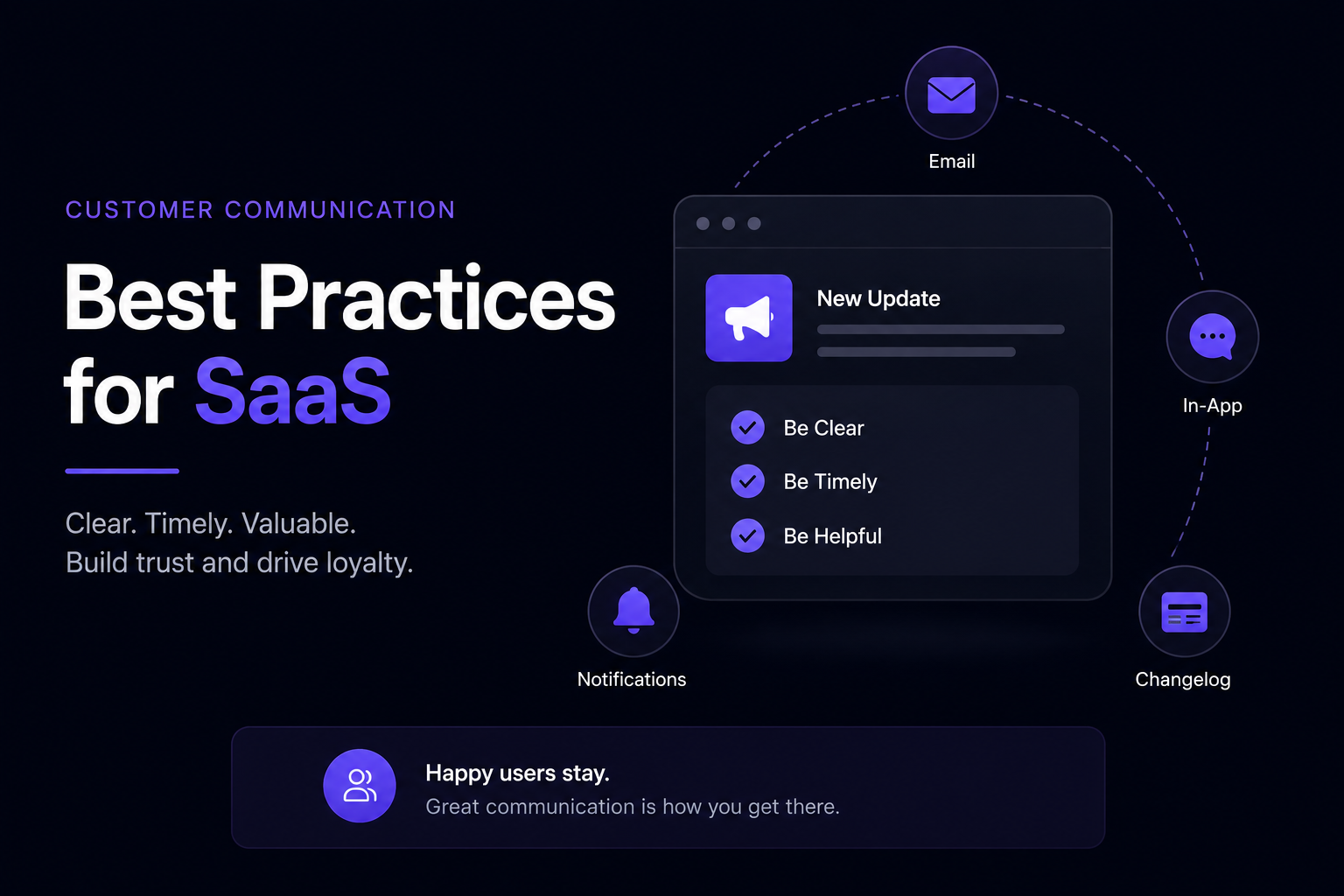
The most effective launches use multiple communication channels.
For example:
Publish a detailed changelog entry.
Show an in-app announcement.
Send an email for major releases.
Share the launch on social media.
Publish a blog post for larger features.
Update your documentation or help center.
Using multiple channels increases the chances that customers will discover and adopt the feature.
How can I increase feature adoption after launch?
Continue talking about the feature after launch day.
Highlight it in your onboarding flow, mention it in newsletters, include it in tutorials, and monitor customer feedback to improve the experience.
Many successful features gain traction gradually rather than immediately after launch.
How do I measure whether a feature launch was successful?
Success should be measured by customer outcomes rather than announcement metrics.
Useful metrics include:
Feature adoption rate
Active usage
Customer engagement
Retention
Support requests
Customer feedback
Conversion to paid plans (when applicable)
The goal isn't simply to get views on your announcement—it's to help customers adopt the feature.
Should I keep a public changelog?
Yes.
A public changelog gives customers a central place to discover new features, catch up on recent releases, and see how your product has evolved over time.
It also demonstrates that your product is actively maintained and supports your SEO strategy by creating fresh, searchable content.
What's the best tool for announcing new features?
The best tool depends on your team's workflow.
If you're looking for a simple way to publish a public changelog, embed an in-app changelog widget, generate release notes with AI, and automate updates from GitHub and Linear, Announcify provides everything you need to launch new features and keep customers informed.
Conclusion
A successful feature launch is about more than shipping code.
It's about making sure customers discover your new feature, understand why it matters, and feel confident enough to start using it.
Many launches underperform not because the feature lacks value, but because the communication ends too soon. A single announcement is rarely enough to drive adoption. The most successful SaaS teams treat a feature launch as an ongoing process—one that includes clear messaging, thoughtful onboarding, customer feedback, and continuous promotion.
As you prepare your next release, remember these principles:
Validate the problem before you build.
Focus on customer benefits, not just features.
Create a communication plan before launch day.
Use multiple channels to reach your audience.
Measure adoption and improve based on feedback.
Keep a public record of your product's progress.
Every feature you ship is an opportunity to strengthen your product, improve customer relationships, and demonstrate that you're continuously delivering value.
Don't let that opportunity end with deployment.
Launch Every Feature with Confidence
Announcify helps SaaS teams turn feature launches into clear, consistent customer communication.
Publish release notes, maintain a public changelog, announce new features with an in-app changelog widget, and automatically generate updates from GitHub and Linear—all from one place.
Instead of wondering whether customers noticed your latest release, give them a simple way to discover every improvement and stay engaged with your product.
Because a feature launch isn't successful when the code reaches production.
It's successful when customers start using what you've built.
Ahmed Errami
I'm a full stack developer who is passionate about building products that help people. I'm also the founder of Announcify.
Product Updates
Sep 5, 20268 min read
Best AI Release Notes Generators
Manually writing release notes after every deployment takes time. Here are the best AI release notes generators for turning your development workflow into clear, customer-friendly product updates.
 Ahmed Errami